


Cosmetics Alliance recently held the Environmental Symposium on November 20th. Our guest speakers featured industry experts and government officials that provided updates and important information on upcoming environmental and regulatory developments.
Cosmetics Alliance was approached by the Chemical Production and Products Division (CPPD) of Environment and Climate Change Canada (ECCC) to deliver some important information for importers and manufacturers of product subject to the VOC regulations specifically those applying for one of the three alternative compliance options as deficiencies in applications have been detected and the application deadlines are fast approaching.
Mary Ellen Perkin presented this topic at our Environmental Symposium on November 20th and we wanted to share this information with all Cosmetics Alliance members.
There are three alternative compliance options available for importers and manufacturers who are unable to meet the deadline of January 1, 2024 (or for disinfectants which is January 1, 2025):
- Technical or Economic Non-Feasibility (TENF) Permits
- Product Whose Use Results in Lower VOC Emissions (PULE) Permits
- VOC Compliance Unit Trading System (CUTS Permit and Credit)
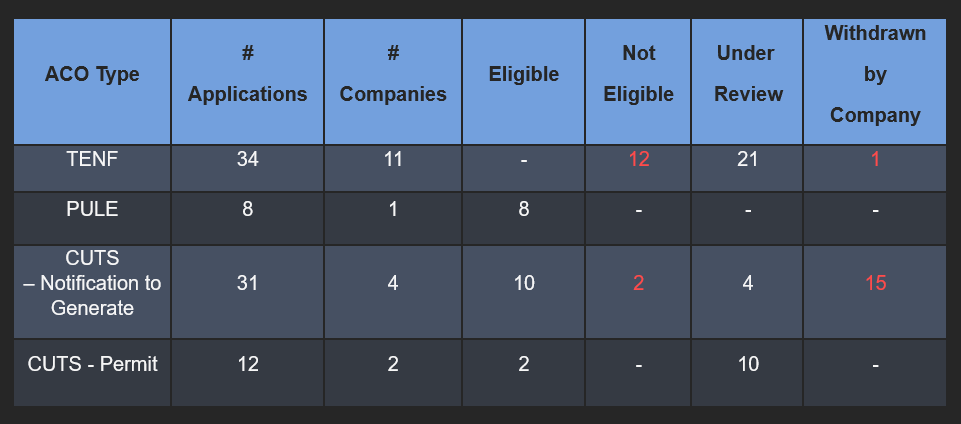
The CPPD provided statistics on the status of applications under each of these options and details on their expectations for each of these options when applying.
As a reminder, TENF and PULE applications need to be submitted and approved by December 31, 2023 (Dec 31, 2024 for disinfectants).
Highlighting some of the challenges:
- Read the applications forms very carefully.
- Complete packages are required.
- If information is not received upon request, the application will be rejected.
TENF
- Evidence that it is not technically feasible.
- The bar has been set high.
- Given other companies have been able to come into compliance, what is unique or special about your situation that makes you unable to comply?
- As yourself if your situation is really a technical problem.
- Evidence that it is not economically feasible.
- The bar has been set high.
- Provide information that puts the economical non-feasibility into context to demonstrate an economic hardship versus a loss in revenue.
- Requires very detailed financial information to demonstrate this financially.
- Each of the above needs to include a realistic plan to identify detailed steps to ensure the product will meet the limit at the end of the permit period. The dates in the plan need to be lined up with the timeline for the permit.
- Read each section of the application carefully and answer/supply information for each element. Incomplete applications will be rejected.
PULE
One application for several products has been received and all have been approved.
This application allows for innovative products to exceed the VOC limit, if, as a result of product design, the product emits lower VOCs when used according to directions for use (for example: limited metered dose products) as compared to a comparable compliant product.
The CPPD is open to having conversations with applicants ahead of applications by reaching out to them at Produits-Products@ec.gc.ca
CUTS
- This year, the ability to apply for generating compliance units has passed. The deadline is October 1st each year in which you wish to start earning compliance units.
- Provide a plan to compensate VOC more than limits by earning or trading compliance units.
- They are checking the math and reporting of actual quantities is required by March 1st of the following year.
- If trading units do not balance the permits will be revoked. You need to do what you have committed to.
General helpful hints for a successful ACO submission from the CPPD:
- The application must be from a manufacturer or importer in Canada.
- The authorized representative can be from outside of Canada.
- Requirements for each of the alternative compliance options are outlined in the corresponding application or reporting form.
- Ensure that you address all the requirements outlined in the forms.
- Where evidence is requested, you may be required to provide copies of testing or technical data to allow ECCC to verify the information provided.
- When asked for a plan, ensure it is sufficiently detailed and shows clearly how you will meet the objective within the timeframe requested in the permit application.
- Double check your math, and ensure your calculations and conversions are correct.
- It is helpful if you show your calculations.
- The application must be signed.
- To help us process your request more quickly, please follow the format/storyline of the application form.
- If we have to search for the required regulatory requirements in your application, it takes longer, and risks that we may miss important information
Company names and product names will be posted on ECCC’s compliance options website for permits which have been issued.
Members had a chance to ask questions directly to ECCC during our Environmental Symposium and we were pleased with the immense interest shown to VOCs from our membership, and rightfully so as limits on VOC concentrations take effect on January 1, 2024 except for disinfectants, whose limits take effect on January 1, 2025.
A copy of the presentation is available here: