


Cosmetics Alliance Canada is alerting members to a significant increase in the number of CAS Registry Numbers (CAS RNs) identified by Environment and Climate Change Canada (ECCC) in association with the Prohibition of Certain Toxic Substances Regulations, 2025.
When the 2025 Regulations were published, the regulatory materials identified two new substance categories: Dechlorane Plus (DP) and decabromodiphenyl ethane (DBDPE). Based on the information provided at the time, the potential impact on the cosmetics and personal care products sector appeared to be limited.
However, thanks to a member’s review of ECCC’s Substances Search Tool list, it has come to our attention that there has been a substantial increase in the number of CAS RNs associated with the Regulations.
From 209 to 3,218 CAS RNs
The ECCC Substances Search Tool listing previously identified approximately 209 CAS RNs associated with the Prohibition of Certain Toxic Substances Regulations, 2012. The current listing identifies 3,218 CAS RN entries associated with the 2025 Regulations.
This represents an increase of more than 3,000 CAS RN entries.
Importantly, this does not mean that more than 3,000 new substances were added to the Regulations. The 2025 Regulations regulate defined substances and substance classes, including broad structural definitions for certain PFAS. The CAS RNs identified by ECCC represent individual substances known to fall within those definitions.
ECCC describes the CAS RNs in its Substances Search Tool listing as a “non-exhaustive” number of CAS RNs known to represent the regulated substances and notes that they are “provided as a guide to understanding the intent of the 2025 Regulations. If a substance meets the definition in the Regulations, the Regulations apply whether, or not, a CAS RN is associated with this substance” or listed in the Substances Search Tool listing.
This distinction is important when using the CAS RN listings to assess product and ingredient compliance.
Cosmetic-relevant Substances
Given the significant increase in CAS RNs, the CA Canada Regulatory Team, with the help of our Personal Care Product Council (PCPC) colleagues reviewed the ECCC listing to identify substances with an INCI name thereby indicating potential relevance to finished cosmetic formulations. Note: This cross-referencing exercise would not cover substances in cosmetic product packaging, labelling, or components of a final product.
This review identified 13 CAS RNs with an identified cosmetic ingredient (INCI) name, including five CAS RNs newly identified in the 2025 listing.
Cosmetic-relevant CAS RNs
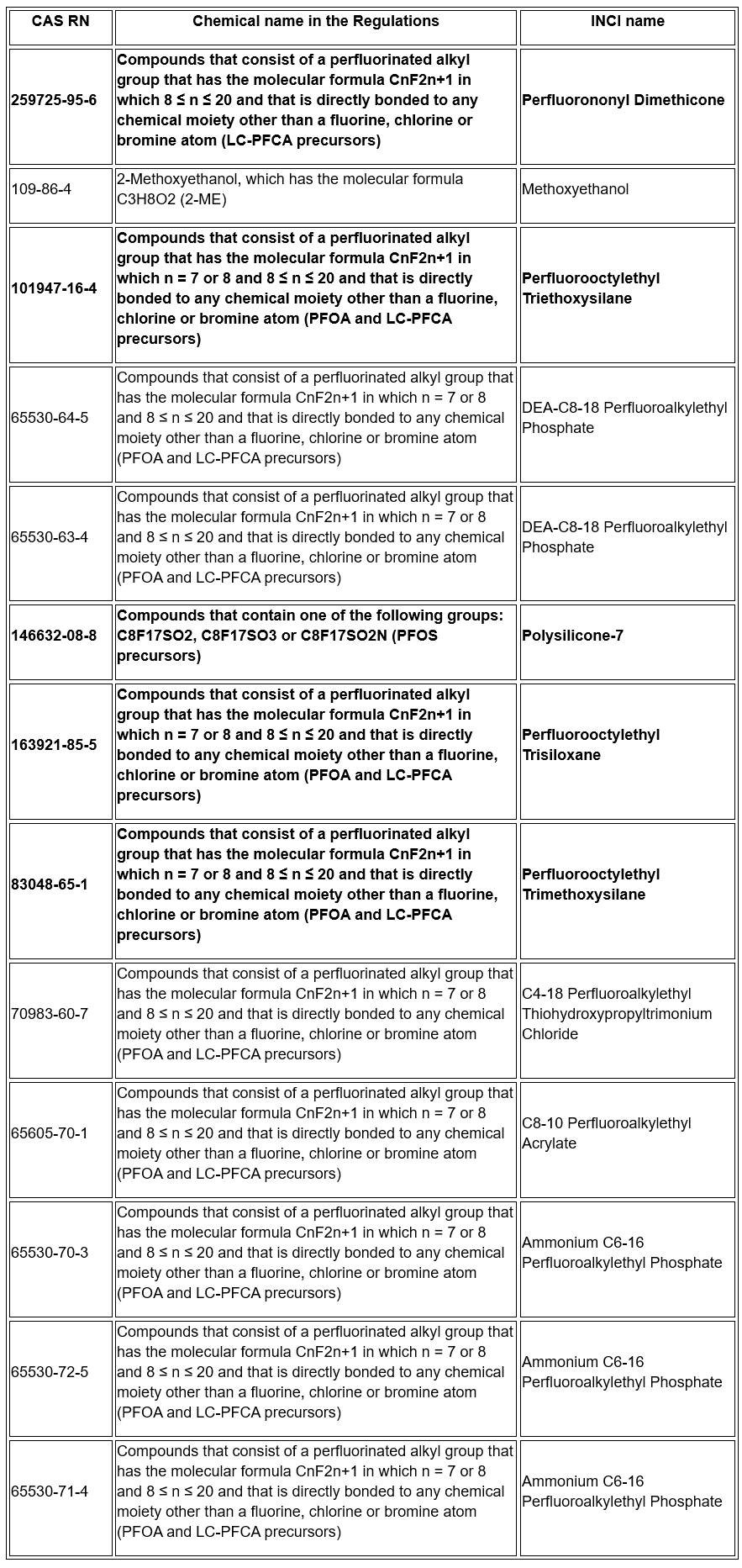
***Bold = CAS RNs newly identified by CA Canada as cosmetic-relevant in the 2025 listing.
***This review is a screening exercise based on the information available in the ECCC Substances Search Tool. The presence or absence of a CAS RN in the database does not determine whether a substance is subject to the Regulations; the applicable regulatory definitions prevail.
What this means for members
As outlines above, members should be aware that the CAS RN listings do not represent a closed list of regulated substances. The Regulations apply to the defined substance groups and classes, which can capture substances that share specified structural characteristics.
CA Canada recommends that members:
- Review cosmetic ingredients and formulations against the relevant substance groups and definitions in the 2025 Regulations, using the ECCC CAS RN listings as a supporting resource.
- Assess relevant packaging, components and other materials associated with cosmetic products, as these may also be implicated.
- Confirm compliance with the applicable prohibitions and exemptions, including with suppliers where additional information is required.
CA Canada advocacy
CA Canada is raising the significant increase in CAS RNs identified by ECCC—from 209 under the 2012 Regulations to 3,218 under the 2025 Regulations—as a transparency and stakeholder communication issue.
While the 2025 Regulations identify only two new substance categories, the substantial increase in CAS RNs associated with the Regulations was not apparent from the updated regulatory materials, as published. CA Canada believes stakeholders would have benefited from clearer information about the substances captured by the broader regulatory definitions and the extent of the change from the previous Regulations.
CA Canada is engaging with ECCC to better understand how this information was developed and how future regulatory changes of this nature can be communicated more transparently to stakeholders.
CA Canada will keep members informed of any further developments.